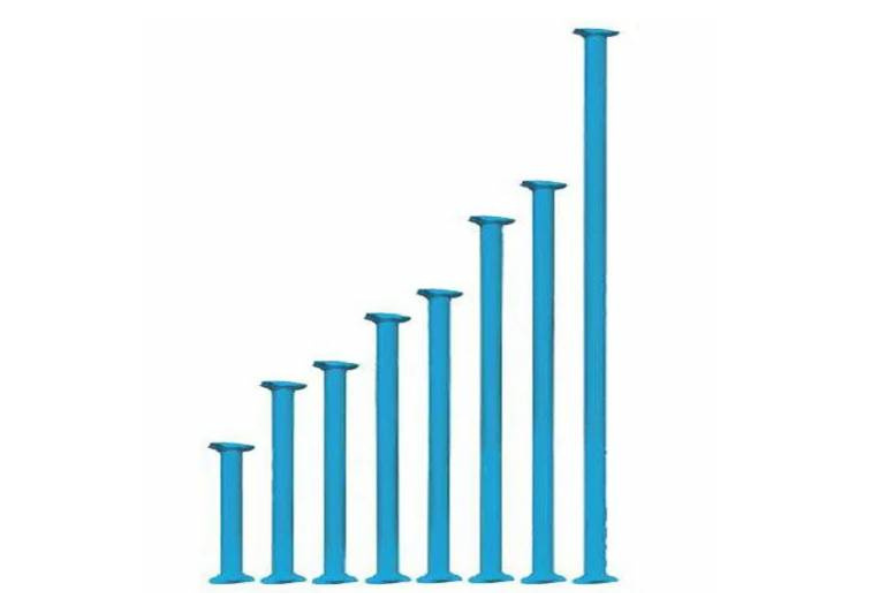
A ledger is a horizontal structural member in a scaffolding system that connects vertical standards and provides lateral stability and load distribution. It plays a crucial role in maintaining the structural integrity of the scaffold by forming horizontal ties between upright supports and helping transfer loads safely across the framework.
1️⃣ Function of a Ledger
The primary functions of a ledger are:
Connecting vertical standards
Supporting transoms and scaffold boards
Providing horizontal stiffness
Distributing loads evenly between standards
Improving overall structural stability
Without ledgers, scaffolding would lack lateral strength and could easily sway or collapse under load.
2️⃣ Standard Dimensions (Numeric Facts)
In most scaffolding systems (Cuplock, Tube & Fittings, Ringlock), ledgers typically have:
Outside Diameter (OD): 48.3 mm
Wall Thickness: 3.2 mm – 4.0 mm
Material: Mild Steel (MS), Yield Strength ≈ 250 MPa
Common Lengths:
0.6 m
0.9 m
1.2 m
1.5 m
2.0 m
2.5 m
The ledger length determines the bay width of the scaffold.
3️⃣ Load Transfer Role
Ledgers primarily resist:
Bending loads
Shear forces
Minor axial forces
Example:
If a scaffold platform carries 3 kN/m² live load and the bay width is 1.5 m:
Load on ledger ≈ 3 × 1.5 = 4.5 kN per meter
This load is transferred from transoms to ledgers, and then to vertical standards.
4️⃣ Ledger in Different Systems
🔹 Tube & Fittings System
Connected using right-angle couplers
Flexible positioning
Requires manual tightening
🔹 Cuplock System
Ledger blade fits into cup joint
Locked by rotating top cup
Faster assembly
🔹 Ringlock System
Wedge head fits into rosette
Hammer locked
5️⃣ Structural Behavior
Ledgers help:
Reduce effective buckling length of standards
Improve lateral rigidity
Maintain geometry of scaffold bays
If ledger spacing is typically 1.5 – 2.0 meters vertically, it significantly increases stability.