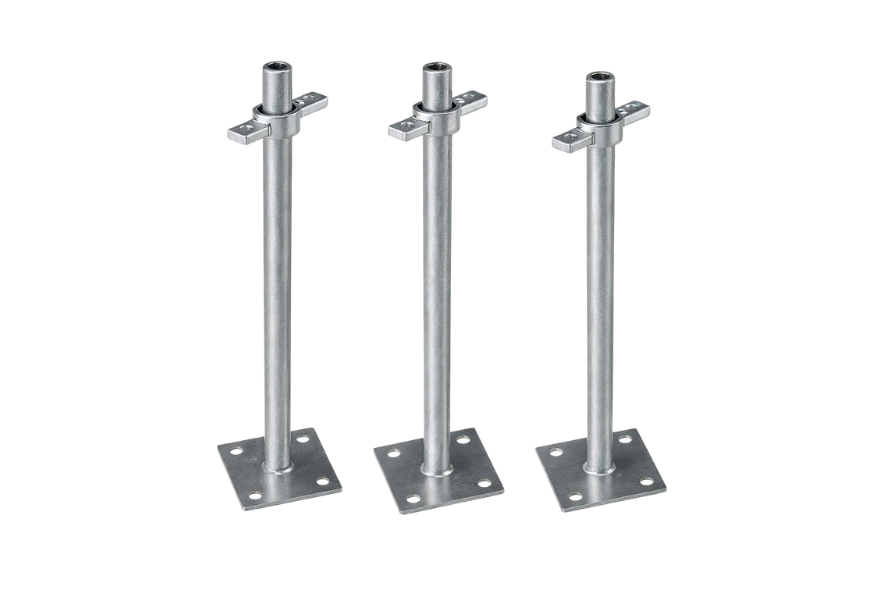
A base jack is a load-bearing adjustable support installed at the bottom of scaffolding standards (vertical pipes). Its primary role is to level, stabilize, and transfer loads safely from the scaffold structure to the ground.
Why Base Jacks Are Necessary
Construction surfaces are rarely perfectly flat. Even a small slope can introduce eccentric loading, which drastically reduces scaffold stability.
Example:
A scaffold leg placed directly on a surface that is just 25 mm uneven can introduce tilting forces.
This can increase bending stresses in standards and reduce load capacity.
Base jacks solve this by allowing fine vertical adjustments.
Typical Dimensions & Numeric Facts
While specifications vary by manufacturer and region, most standard base jacks fall within predictable engineering ranges:
Threaded Stem / Rod
Diameter (common): 30 mm – 38 mm
Length: 400 mm – 600 mm
Thread pitch: ~ 5 – 6 mm per rotation
Meaning:
One full turn of the nut typically changes height by 5–6 mm.
Adjustment Range
Most safety standards limit usable extension:
Recommended extension: ≤ 300 mm
Absolute maximum (varies): ≤ 350 mm – 400 mm
Why?
Excessive extension increases:
Slenderness ratio
Buckling risk
Lateral instability
Base Plate
Typical size: 120 × 120 mm to 150 × 150 mm
Thickness: 4 mm – 6 mm steel
Function:
Distributes vertical load to prevent ground failure.
Example load distribution:
If load on one leg = 20 kN (≈ 2,000 kg)
With 150 × 150 mm plate:
Area = 0.15 × 0.15 = 0.0225 m²
Ground pressure:
Pressure=20,000N/0.0225≈0.89MPaPressure = 20,000 N / 0.0225 ≈ 0.89 MPaPressure=20,000N/0.0225≈0.89MPa
Smaller plates → Higher ground pressure → Risk of sinking.
Load Capacity (Very Important)
Base jacks are structural components designed for compressive loads.
Typical safe working load (SWL):
Light duty: 20 – 25 kN (≈ 2 – 2.5 tons)
Medium duty: 30 – 35 kN
Heavy duty: 40 – 50 kN
Actual capacity depends on:
✅ Stem diameter
✅ Steel grade
✅ Thread engagement
✅ Extension length