

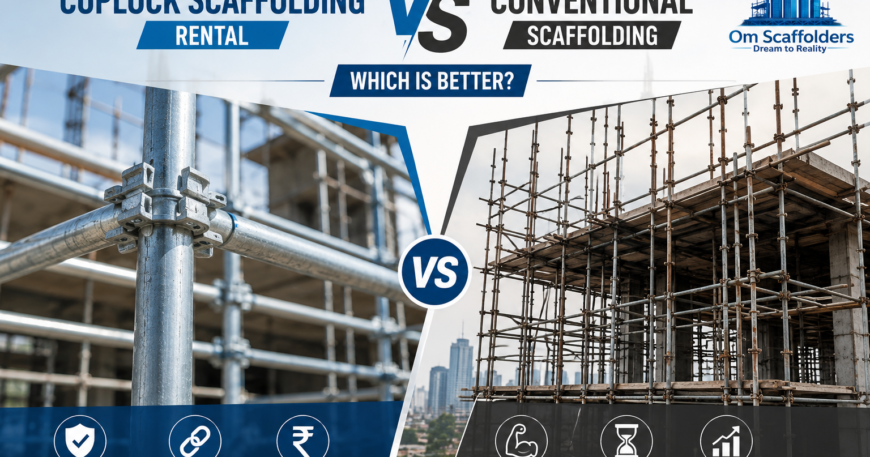
Every construction schedule depends on how fast a crew can get scaffolding up and working safely. Two systems dominate Indian job sites today: cuplock scaffolding rental and conventional tube and fitting scaffolding. Both do the same basic job, but they behave very differently on site.
Contractors who choose the wrong system often lose days to slow assembly, or spend more than needed on labour and maintenance. This guide compares cuplock scaffolding rental with conventional scaffolding across speed, safety, load capacity and cost, so you can pick the right one for your next project.
What is Cuplock Scaffolding?
Cuplock scaffolding is a modular system built around vertical standards fitted with fixed and rotating cups at regular intervals. Horizontal ledgers lock into these cups with a single hammer strike. No bolts, no loose clamps.
This interlocking design cuts assembly time significantly compared with traditional systems. Because every joint connects the same way, even a crew with limited scaffolding experience can erect it correctly with basic training.
The system works best for repetitive bay structures such as multi-storey buildings, bridges and industrial platforms, which is why cuplock scaffolding on rent has become the default choice for contractors handling large, standardised structures across India.
What is Conventional Scaffolding?
Conventional scaffolding, also known as tube and fitting scaffolding, uses separate steel tubes joined by loose couplers and clamps. Every joint is fixed by hand, which gives the crew full control over the shape and layout of the structure.
That flexibility is useful for irregular surfaces, curved facades and heritage buildings, where standard bay sizes simply will not fit. The trade-off is speed. Each coupler has to be positioned and torque-checked individually, which adds labour hours to both erection and dismantling.
Cuplock Scaffolding Rental vs Conventional Scaffolding
| Factor | Cuplock Scaffolding Rental | Conventional Scaffolding |
| Assembly Speed | Fast, cup-and-ledger locking | Slower, coupler by coupler |
| Labour Requirement | Lower, basic training sufficient | Higher, skilled riggers needed |
| Load Capacity | High and consistent per bay | Varies with joint tightening |
| Flexibility | Best for repetitive, standard bays | Best for irregular, custom shapes |
| Safety Inspection | Easy, uniform joints | Needs individual torque checks |
| Maintenance | Lower, fewer loose parts | Higher, more components to track |
| Best Suited For | High-rise, industrial, bridges | Heritage work, curved facades |
Advantages of Cuplock Scaffolding Rental
Cuplock scaffolding rental brings several practical benefits to a busy site.
- Faster erection and dismantling, since ledgers lock into cups without separate fittings
- Fewer loose parts, which means less time spent searching for the right clamp or bolt
- Lower labour cost per bay because fewer workers are needed for the same span
- Consistent load transfer through every standard, which supports predictable scaffolding manufacturing quality
- Easier inspection, since every joint locks the same way and faulty connections are easy to spot
For high-rise buildings, factories and bridge work, these advantages translate directly into shorter project timelines.
When Conventional Scaffolding is the Better Choice
Conventional scaffolding still earns its place on certain sites. Choose it when:
- The structure has curved, angled or non-standard geometry that a fixed-bay system cannot follow
- Work involves heritage restoration, where the scaffold must trace an irregular facade
- The project needs a highly customised platform for a short, specific task
- Access points must change frequently during the same project
In these cases, the extra assembly time is a fair trade for the flexibility conventional scaffolding provides.
A site supervisor’s own experience often settles the debate faster than any spec sheet. On a straightforward tower block, a crew familiar with cuplock can close out a full lift in a fraction of the time a coupler-based system would take. On a heritage renovation with sloped parapets, that same crew reaches for conventional tube and fitting without a second thought.
Which Scaffolding System is More Cost-Effective?
Cost depends on more than the rental rate per kilogram. Cuplock scaffolding rental usually works out cheaper on projects with repetitive floor plans, because faster assembly means fewer labour hours billed and less scaffold sitting idle.
Conventional scaffolding can still be cost-effective on smaller, irregular jobs where a cuplock system would need extra customisation to fit. For most standard commercial and industrial builds, though, the labour savings from faster cuplock erection outweigh the marginal difference in rental rate.
It also helps to look at total project duration. A system that gets workers onto the structure two or three days earlier often saves more than the scaffolding invoice ever will.
Which Industries Benefit Most from Cuplock Scaffolding?
Cuplock scaffolding rental suits industries where standardised, repeatable bays are the norm:
- Residential and commercial high-rise construction
- Industrial plants and factory shutdowns, where uptime is critical
- Power and energy projects that need fast, safe access at height, similar to the setups used in power and energy project support
- Bridge and infrastructure work with long, repeated spans
- Shuttering and formwork applications, where cuplock towers support shuttering and formwork systems during concrete pours
Sectors with irregular, one-off structures, such as restoration work or ornamental facades, tend to rely more on conventional scaffolding or a mix of both systems.
Procurement teams evaluating a new system should also factor in safety compliance. Cuplock towers used for shuttering support carry defined load ratings per bay, which makes it easier for site engineers to plan formwork loads accurately before concrete pours begin. Conventional scaffolding requires more manual load calculation, since every configuration is slightly different.
Why Choose Om Scaffolders?
Om Scaffolders supplies both cuplock and conventional scaffolding systems, along with steel planks and other accessories, so contractors are not locked into one approach. Every component is manufactured in-house and checked against IS 4014 standards before it leaves the yard.
With pan-India delivery, trained erection teams and flexible rental durations, Om Scaffolders helps contractors match the system to the site rather than the other way round. The full range of scaffolding products and services is available for review before you commit to a rental plan.
Conclusion
Cuplock scaffolding rental wins on speed, labour cost and consistency for standard, repetitive structures. Conventional scaffolding still has a role wherever a site needs custom geometry or short-term flexibility. The right call depends on your building layout, timeline and budget, not on which system sounds more modern.
If you are planning a project and want expert advice on which system fits your site, get in touch with our team for a quote tailored to your requirements.
FAQs – Cuplock Scaffolding Rental vs Conventional Scaffolding
1. Which is better, Cuplock or conventional scaffolding?
A: Cuplock scaffolding rental is faster to erect and more cost-effective for standard, repetitive structures. Conventional scaffolding is better suited to irregular geometry or custom, short-term platforms.
2. Is Cuplock scaffolding safer?
A: Yes, in most cases. The fixed cup-and-ledger joints reduce the risk of loose or missing fittings, and every connection is easy to inspect visually, which lowers the chance of assembly errors on site.
3. When should I rent Cuplock scaffolding?
A: Rent cuplock scaffolding for multi-storey buildings, industrial platforms, bridges and any project with repeated bay sizes, especially when the timeline is tight and labour needs to be minimised.
4. Is Cuplock scaffolding suitable for high-rise buildings?
A: Yes. Its high load capacity and stable vertical standards make it a common choice for high-rise residential and commercial towers across India, where speed and structural reliability both matter.
5. What factors affect Cuplock scaffolding rental cost?
A: Rental cost depends on the quantity of material, rental duration, project location and delivery timelines. Long-term contracts and bulk orders usually come with preferential pricing.
6. How do I choose a reliable scaffolding rental company?
A: Look for IS-compliant material, in-house manufacturing, pan-India delivery capability and a track record of on-time supply. Checking client reviews and asking for project references also helps.